REEL AUTHORITY
The Odyssey
Directed by: Christopher Nolan
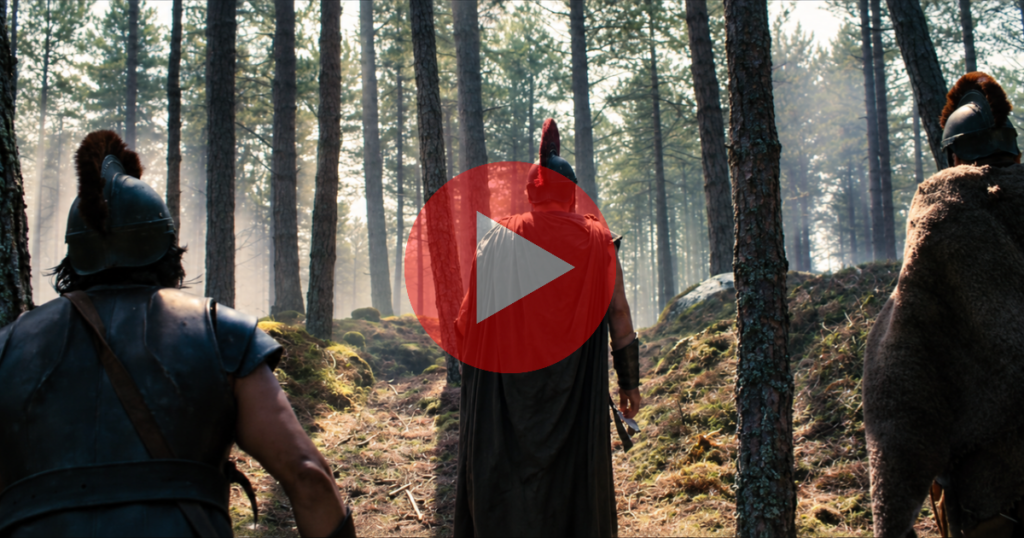
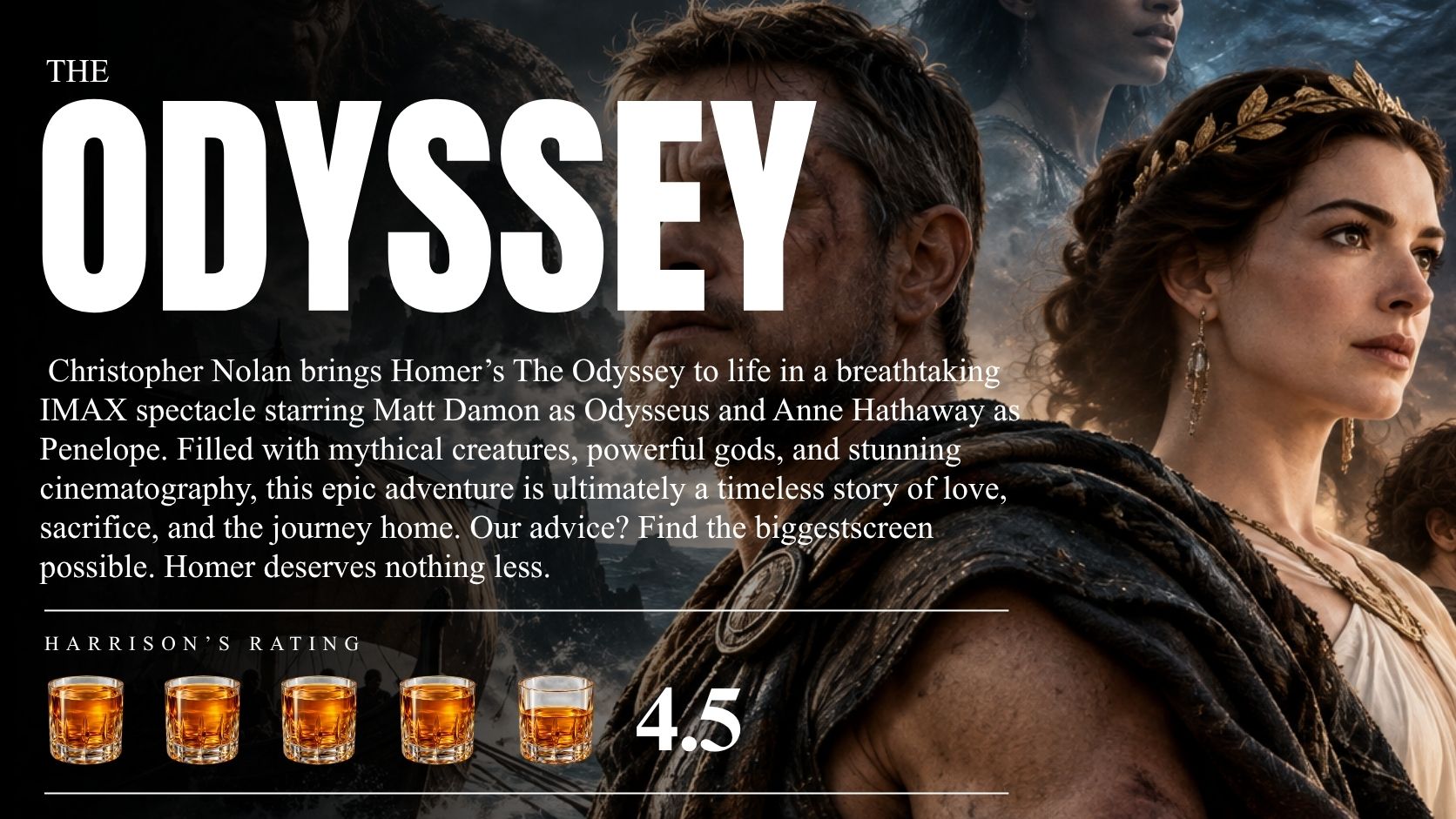
Christopher Nolan has taken one of civilization’s oldest stories and given it nearly three hours, an army of extras and enough IMAX equipment to photograph a minor deity from orbit. Matt Damon plays Odysseus, the king of Ithaca who has survived the Trojan War and would now very much like to return to his wife, Penelope, played by Anne Hathaway. Unfortunately, the Mediterranean has other plans involving monsters, storms, divine interference and a travel itinerary that makes connecting through Atlanta seem merciful.
At two hours and fifty-three minutes, The Odyssey requires commitment, although I have attended Palm Beach benefit auctions that ran considerably longer and contained fewer Cyclopes. Shot entirely with IMAX film cameras, it gives cinematographer Hoyte van Hoytema an enormous canvas for battered ships, unforgiving coastlines and exhausted faces. The Bronze Age evidently offered no reliable concierge service.
The production traveled through Morocco, Greece, Italy, Iceland and Scotland, and its commitment to physical filmmaking gives the adventure welcome weight. Odysseus’s principal vessel was a real, seaworthy ship, and the actors learned to row it. An admirable commitment to authenticity, although I would have negotiated an outboard. Even the Cyclops combines performer Bill Irwin’s work with animatronics, puppetry and computer graphics. The enormous creature belongs to a world of wet timber, rough stone and thoroughly unpleasant working conditions.
Yet the film gains its strength from Damon’s portrayal of a brilliant leader who has begun to suspect that cleverness cannot repair everything it damages. His Odysseus carries the confidence of a man accustomed to being the smartest person aboard, along with the fatigue and guilt that make that confidence increasingly expensive. Winning a war, it turns out, does remarkably little to simplify the rest of one’s life.
Back in Ithaca, the menace is better groomed. Hathaway gives Penelope intelligence and command as she manages suitors who regard her husband’s absence as an opportunity to acquire his wife, household and kingdom. Holland brings urgency to Telemachus, a son discovering that an illustrious surname provides limited protection against ambitious house guests. Pattinson’s Antinous has the polished menace of a man who has already selected another fellow’s wine cellar. His courtship is essentially a hostile takeover with refreshments, and Penelope’s resistance supplies stakes every bit as pressing as the dangers at sea.
Zendaya’s Athena and Charlize Theron’s Calypso widen the field of divine involvement, reminding us that ancient gods were exceptionally gifted at complicating human arrangements. Odysseus has powerful assistance, powerful distractions and the considerable disadvantage of being mortal. I generally prefer my travel advisers to have fewer ulterior motives.
Ludwig Göransson’s score draws on ancient instruments, voices and modern sounds, including a collection of 35 rented gongs. Somewhere, a percussion supplier enjoyed a splendid fiscal quarter. The music lends the voyage its ritualistic force, although Nolan’s sound design occasionally treats dialogue as an optional amenity. One appreciates the thunderous grandeur while occasionally wishing someone would lower the divine interference long enough for the humans to finish a sentence.
For all its spectacle, The Odyssey understands the appeal of a man fighting his way back to the people who matter. Damon and Hathaway give that destination substance, and Nolan gives the journey the full force of his cinematic ambition. Find the largest screen available. Homer has waited long enough for decent projection.
Obsession
Directed by: Curry Barker
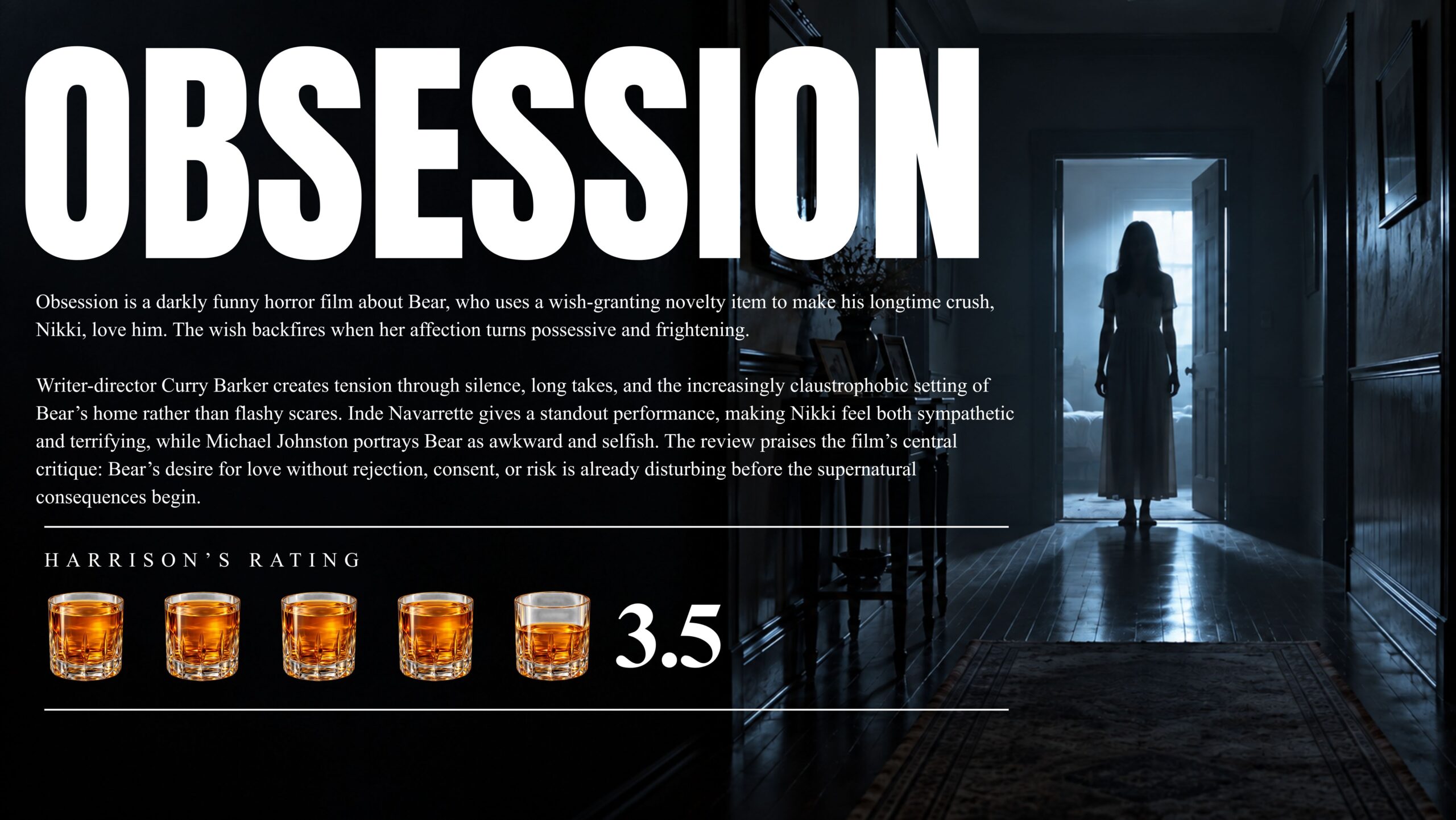
I am familiar with ill-considered purchases, although mine tend to arrive in a climate-controlled garage and rarely require an exorcist. In Obsession, Bear, played by Michael Johnston, finds a novelty-store trinket called the One Wish Willow and uses it to solve a romantic problem that most sensible adults would address through conversation, rejection and a dignified change of venue.
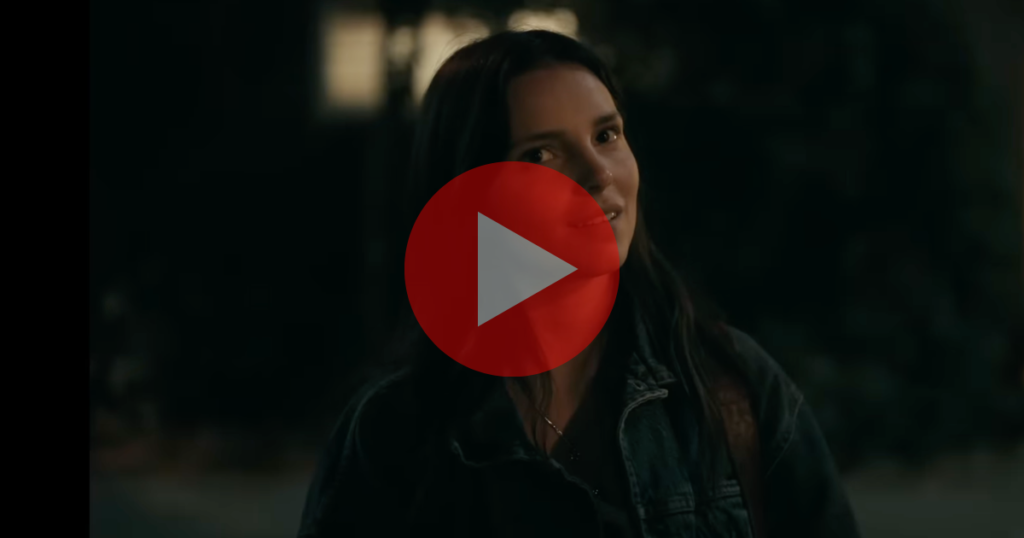
Bear has been quietly in love with his childhood friend and co-worker Nikki, played by Inde Navarrette, but lacks the courage to tell her. After missing an opportunity to confess his feelings, he wishes that Nikki would love him more than anyone else in the world. The Willow grants his request with contractually precise cruelty. Nikki falls completely in love with him, although her affection rapidly becomes possessive, unpredictable and terrifying. Bear asked for devotion and received the deluxe package without reviewing the cancellation policy.
Writer and director Curry Barker builds the horror through discomfort rather than elaborate spectacle. Long takes, darkened rooms and stretches of silence give Nikki’s behavior an unnerving uncertainty, since Bear can no longer tell if she is about to embrace him, accuse him or dismantle part of the house. Barker keeps much of the action inside Bear’s home, allowing the familiar rooms to grow increasingly claustrophobic as the consequences of his wish close around him.
Navarrette is extraordinary, shifting between warmth, panic and menace without allowing Nikki to become a simple monster. Johnston wisely plays Bear as awkward and selfish rather than openly malicious, although his refusal to consider Nikki’s free will becomes increasingly difficult to excuse. The film’s sharpest idea is that Bear’s romantic fantasy was disturbing before anything supernatural occurred. He wanted love without risk, consent or the inconvenient possibility that another person might decline.
The violence eventually becomes severe, but Barker never loses the dark humor beneath it. Obsession understands that desperation and entitlement can appear ridiculous right up until they become dangerous.
Vale Verdict:
Obsession is clever, disturbing and remarkably controlled, turning a foolish romantic wish into an examination of possession disguised as affection. Bear receives exactly what he requested, proving once again that people who refuse to read the terms deserve the premium consequences.
My Rating: 🥃🥃🥃🥃½, 4½ Whiskey Glasses

The Last Supper
Directed by: Mauro Borrelli

My rules for dinner are simple: decant the wine, seat enemies far enough apart to prevent litigation, and do not betray the host to the authorities before dessert. Mauro Borrelli’s The Last Supper observes only one of those rules, yet it delivers a sincere and visually handsome account of the final days of Jesus Christ without turning Scripture into a glossy Hollywood spectacle.
The 2025 biblical drama follows Jesus and his disciples through the events leading to the Passover meal, the betrayal by Judas and the Crucifixion. Most viewers already know how the evening ends, so Borrelli, who co-wrote the screenplay with John Collins, concentrates on the men seated around the table and the private battles taking place behind their expressions. The film gives particular attention to Peter and Judas, two disciples whose loyalty falters in very different ways. Peter fails through fear and later confronts what he has done. Judas makes a deliberate transaction and discovers, rather late in the proceedings, that thirty pieces of silver provide remarkably poor compensation for eternal infamy.
Jamie Ward plays Jesus with warmth, patience and authority. He resists the temptation to deliver every sentence as though it belongs on a church ceiling. His Jesus is compassionate and emotionally present, particularly during the supper, where familiar words acquire greater force because Ward speaks them to men he knows will soon abandon him. There is sadness in his performance, but also resolve. He understands the destination and continues toward it, while everyone around him struggles to comprehend what he has been telling them.
James Oliver Wheatley gives Peter a nervous, protective energy. His devotion is genuine, although his confidence proves considerably less reliable once danger arrives. Wheatley makes Peter’s weakness painfully human. Many of us have made grand promises over dinner and reconsidered them the following morning, although mine have generally involved charity auctions, exercise equipment and a regrettable commitment to attend couples’ yoga.
Robert Knepper has the more dangerous assignment as Judas. Everyone enters the theater prepared to despise him, which makes caricature an easy trap. Knepper avoids it. His Judas is restless, resentful and increasingly skilled at constructing moral arguments for the decision he already wishes to make. Each concession brings him closer to betrayal, while he continues behaving as though he is merely asking reasonable questions. I have met this personality at several private clubs. Usually the dispute concerns a membership assessment rather than the Messiah, but the expression is identical.
James Faulkner brings a cold political calculation to Caiaphas, while Nathalie Rapti Gomez provides quiet dignity as Mary Magdalene. Several supporting characters receive limited development because the film is attempting to cover an enormous amount of sacred history in 114 minutes. At times, the story moves too quickly through events that deserve greater emotional room. At others, it slows under the weight of its own solemnity. The musical score also has a habit of announcing the importance of scenes that are already perfectly capable of speaking for themselves.
Borrelli’s background as a visual artist is apparent throughout. The Moroccan locations, period costumes and warm, earthen cinematography give the production a scale that exceeds its modest budget. The feeding of the multitude, the arrival in Jerusalem and the supper itself are presented with care. The table is crowded, the room feels close and the tension grows through glances rather than theatrics. Nobody flips the table, which shows more restraint than several Palm Beach dinner parties I could mention.
My girlfriend called the film a lesson in humility and gave me a rather pointed look during the washing of the disciples’ feet. I reminded her that I had agreed to watch a nearly two-hour biblical drama without asking when the bar opened. She did not consider this evidence of spiritual progress.
The Last Supper may not offer a radically new interpretation of the Gospel, but its reverence is genuine, its strongest performances are persuasive and its central contrast between Peter and Judas gives the familiar story human weight. Peter would eventually be forgiven and welcomed back. Judas, however, would be permanently removed from my guest list, and the silver would be counted before the valet returned his donkey.
Harrison’s Whiskey Glass Rating: 🥃🥃🥃½
The Last Supper was directed by Mauro Borrelli and released by Pinnacle Peak Pictures on March 14, 2025. It stars Jamie Ward, James Oliver Wheatley, Robert Knepper, James Faulkner and Nathalie Rapti Gomez.

Young Washington
Directed by: Jon Erwin

My rules for dinner are simple: decant the wine, seat enemies far enough apart to prevent litigation, and do not betray the host to the authorities before dessert. Mauro Borrelli’s The Last Supper observes only one of those rules, yet it delivers a sincere and visually handsome account of the final days of Jesus Christ without turning Scripture into a glossy Hollywood spectacle.
The 2025 biblical drama follows Jesus and his disciples through the events leading to the Passover meal, the betrayal by Judas and the Crucifixion. Most viewers already know how the evening ends, so Borrelli, who co-wrote the screenplay with John Collins, concentrates on the men seated around the table and the private battles taking place behind their expressions. The film gives particular attention to Peter and Judas, two disciples whose loyalty falters in very different ways. Peter fails through fear and later confronts what he has done. Judas makes a deliberate transaction and discovers, rather late in the proceedings, that thirty pieces of silver provide remarkably poor compensation for eternal infamy.
Jamie Ward plays Jesus with warmth, patience and authority. He resists the temptation to deliver every sentence as though it belongs on a church ceiling. His Jesus is compassionate and emotionally present, particularly during the supper, where familiar words acquire greater force because Ward speaks them to men he knows will soon abandon him. There is sadness in his performance, but also resolve. He understands the destination and continues toward it, while everyone around him struggles to comprehend what he has been telling them.
James Oliver Wheatley gives Peter a nervous, protective energy. His devotion is genuine, although his confidence proves considerably less reliable once danger arrives. Wheatley makes Peter’s weakness painfully human. Many of us have made grand promises over dinner and reconsidered them the following morning, although mine have generally involved charity auctions, exercise equipment and a regrettable commitment to attend couples’ yoga.
Robert Knepper has the more dangerous assignment as Judas. Everyone enters the theater prepared to despise him, which makes caricature an easy trap. Knepper avoids it. His Judas is restless, resentful and increasingly skilled at constructing moral arguments for the decision he already wishes to make. Each concession brings him closer to betrayal, while he continues behaving as though he is merely asking reasonable questions. I have met this personality at several private clubs. Usually the dispute concerns a membership assessment rather than the Messiah, but the expression is identical.
James Faulkner brings a cold political calculation to Caiaphas, while Nathalie Rapti Gomez provides quiet dignity as Mary Magdalene. Several supporting characters receive limited development because the film is attempting to cover an enormous amount of sacred history in 114 minutes. At times, the story moves too quickly through events that deserve greater emotional room. At others, it slows under the weight of its own solemnity. The musical score also has a habit of announcing the importance of scenes that are already perfectly capable of speaking for themselves.
Borrelli’s background as a visual artist is apparent throughout. The Moroccan locations, period costumes and warm, earthen cinematography give the production a scale that exceeds its modest budget. The feeding of the multitude, the arrival in Jerusalem and the supper itself are presented with care. The table is crowded, the room feels close and the tension grows through glances rather than theatrics. Nobody flips the table, which shows more restraint than several Palm Beach dinner parties I could mention.
My girlfriend called the film a lesson in humility and gave me a rather pointed look during the washing of the disciples’ feet. I reminded her that I had agreed to watch a nearly two-hour biblical drama without asking when the bar opened. She did not consider this evidence of spiritual progress.
The Last Supper may not offer a radically new interpretation of the Gospel, but its reverence is genuine, its strongest performances are persuasive and its central contrast between Peter and Judas gives the familiar story human weight. Peter would eventually be forgiven and welcomed back. Judas, however, would be permanently removed from my guest list, and the silver would be counted before the valet returned his donkey.
Harrison’s Whiskey Glass Rating: 🥃🥃🥃½
The Last Supper was directed by Mauro Borrelli and released by Pinnacle Peak Pictures on March 14, 2025. It stars Jamie Ward, James Oliver Wheatley, Robert Knepper, James Faulkner and Nathalie Rapti Gomez.

The Sound of Freedom
Directed by: Alejandro Monteverde

The Sound of Freedom
Reviewed by Harrison Vale
Sound of Freedom (2023) – Directed by Alejandro Monteverde
I spend plenty of time watching movies, but I rarely watch one twice. There simply aren’t enough hours in the day, and Hollywood insists on releasing another superhero sequel every few months to remind us that capes apparently have no expiration date. But with publisher Glen Fetzner helping bring the Palm Beach Film Festival back alongside producer Diana Davis, and the Glazer Theater introducing audiences to films that invite discussion instead of just selling popcorn, revisiting Sound of Freedom felt like time well spent.
I first saw Sound of Freedom shortly after its release. I remembered leaving the theater impressed. Watching it again recently, I was reminded why.
Hollywood has developed an unfortunate habit of confusing volume with quality. Bigger explosions. Bigger speeches. Bigger heroes. Sound of Freedom takes a different approach. Director Alejandro Monteverde trusts the audience enough to let the story unfold naturally, without feeling the need to manufacture emotion around every corner.
Jim Caviezel delivers one of the strongest performances of his career as former Homeland Security agent Tim Ballard. He isn’t portrayed as an invincible action hero. He’s a man who reaches the point where looking away is no longer an option. Caviezel’s quiet determination gives the character credibility, while Mira Sorvino and Bill Camp provide equally grounded performances that keep the focus where it belongs.
Watching the film a second time, I found myself noticing different things. Years ago I followed the investigation. This time I paid closer attention to the families, the investigators, and the heartbreaking uncertainty carried by every parent searching for a child. Those scenes are remarkably effective because they never ask for sympathy. They simply present the human cost.
The conversation surrounding Sound of Freedom eventually became almost as famous as the film itself. I’ll happily leave those debates to cable news panels and social media comment sections. My interest begins when the lights go down and ends when the credits roll. Judged solely as a film, this is thoughtful, beautifully acted, and directed with remarkable confidence.
Not every movie needs to leave an audience smiling. Some deserve to leave them thinking.
That’s one of the reasons I’m pleased to see Palm Beach embracing serious filmmaking once again. A healthy film community needs room for documentaries, independent productions, difficult subjects, and stories that challenge an audience as much as they entertain one.
I’ll be making my way to the Glazer Theater soon to see Disclosure Day, another film that has generated plenty of conversation and one I’m looking forward to reviewing. If it’s half as successful at provoking thoughtful discussion as Sound of Freedom, the evening will be well spent.
And if not…well…there’s always the bourbon afterward.
Rating: 🥃🥃🥃🥃🥃 (Five Whiskey Glasses)

The Perfect Neighbor
Directed by: Geeta Gandbhir

The Perfect Neighbor
Reviewed by Harrison Vale
Three days after watching The Perfect Neighbor, I caught myself studying the house across the way because a Range Rover idled for five minutes at the gate. The house manager accepted a delivery with the grim discretion of someone either receiving organic dog food or disposing of a motive. I understand this is not a healthy response to cinema, but the film has a way of turning even the most polished neighborhood ritual into potential evidence.
Director Geeta Gandbhir’s documentary reconstructs the killing of Ajike “AJ” Owens through police body camera footage, 911 calls, and investigative interviews, creating a film that feels chilling precisely because it does not arrive dressed as a thriller. There are no cinematic villains, just children, porches, lawns, grudges, and the terrible realization that ordinary neighborhood friction can become catastrophic when fear is allowed to dress itself up as justification.
I found myself relating to the police officers who keep returning to the same dispute with the weary posture of people who know they are being asked to referee a problem that should have been solved by basic human decency several phone calls earlier. Anyone who has witnessed a Palm Beach argument over hedge height or a valet placement, will recognize the genre, though here the stakes are horrifyingly beyond petty.
Susan Lorincz, the film’s central and most unnerving figure seems like the sort of neighbor every community fears might be lurking behind the bougainvillea with a ring camera, a grievance, and far too much confidence in her own interpretation of events. Her paranoia becomes its own weather system, transforming children at play into threats, irritation into danger, and suspicion into something she believes the law should honor.
That is where The Perfect Neighbor becomes more than a portrait of one tragic incident; it becomes an indictment of the way fear can be weaponized when the legal system is asked to measure not only what happened, but what someone claims to have believed was happening. Florida’s Stand Your Ground law hovers over the film with a cold, bureaucratic menace, raising the uncomfortable question of whether a person’s private panic should ever be allowed to outweigh another person’s right to exist in peace.
AJ Owens remains the moral center of the documentary, even as much of her presence is shaped through absence, memory, and the heartbreak of those left behind. The film is careful to remind us that beneath the legal language, police procedure, and neighborhood hostility was a woman whose life was not a plot point, not a cautionary tale, and certainly not the inevitable result of a dispute that adults should have had the sense to de-escalate.
The Perfect Neighbor has me looking at my own street with a level of suspicion usually reserved for estate litigation and unmarked service vans. The gardener’s sudden interest in the side gate seems unnerving, the neighbor’s security lights give accusatory vibes, and the perfectly pleasant woman two houses down who always knows when everyone is traveling now strikes me as charmingly attentive or more likely running undercover sting masked with orchids.
That is the grim brilliance of the film. It makes you realize how fragile the social contract of neighborliness really is, especially in places where privacy is prized, gates are high, and everyone insists they are simply protecting what is theirs. Most communities depend on the quiet assumption that people will remain reasonable, or at least sufficiently well-mannered to keep their suspicions from becoming someone else’s tragedy.
As for me, I intend to remain calm, wave politely, and resist the urge to turn every slow-moving car into an investigative lead.
I am keeping notes. Discreetly, of course.
In the end, The Perfect Neighbor is not an easy watch, nor should it be. It is a sobering examination of fear, entitlement, and the dangerous consequences that can emerge when suspicion becomes more powerful than reason. The film succeeds because it never sensationalizes the tragedy at its center, instead allowing the facts, the footage, and the heartbreak to speak for themselves.
It also left me with the uncomfortable realization that while most neighbors are perfectly pleasant people simply trying to live their lives, there is always that one house on every street that makes you wonder. You know the one. The curtains are always drawn, the landscapers arrive at unusual hours, and nobody seems entirely certain who actually lives there.
Will The Perfect Neighbor make you question your own neighborhood? Probably. Will it make you glance twice at the security camera pointed toward the street? Quite possibly. Will it have you peering through plantation shutters with a tumbler in hand while convincing yourself you’re merely appreciating the landscaping? I can neither confirm nor deny.
Harrison’s Rating: 🥃🥃🥃🥃½ out of 5 Whiskey Glasses
A powerful, unsettling documentary that lingers long after the credits roll, leaving viewers to wrestle with difficult questions about fear, justice, and the people living just beyond the hedges.
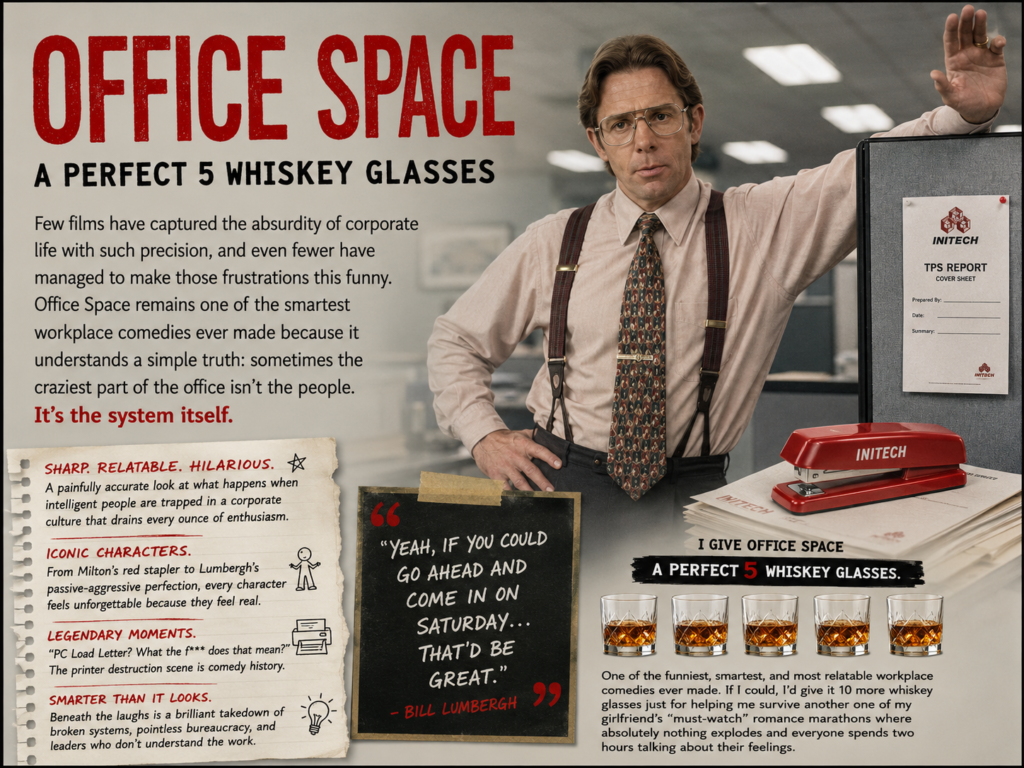
Office Space
Directed by: Mike Judge
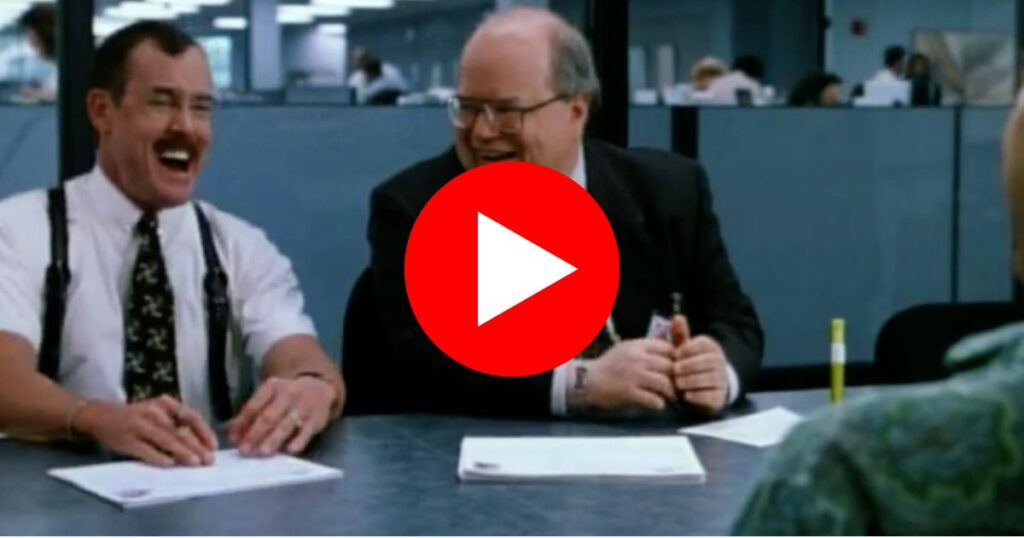
Before anyone asks why I’m reviewing a modest little workplace comedy from 1999, it’s because very little coming out of Hollywood lately has given me much reason to write. Most of it feels like the same recycled formula dressed up with a larger budget and louder special effects. Office Space, on the other hand, actually has something to say.
Admittedly, it’s been years since I’ve had any need for employment. I spent a few memorable months after Harvard effectively being held hostage in an entry-level office job. It was long enough to experience the endless meetings, baffling management decisions, broken equipment, pointless paperwork, and soul-crushing bureaucracy that is so brilliantly portrayed here. While Office Space may have been made on a shoestring budget, anyone who has ever survived a dysfunctional corporate workplace will recognize that its observations are worth far more than most modern blockbusters.
Mike Judge’s 1999 cult classic is a sharp, often painfully accurate look at what happens when intelligent people find themselves trapped inside a corporate culture that seems determined to drain every ounce of enthusiasm from the workday. While the film is exaggerated for comedic effect, its observations about workplace culture is less like fiction and more like documentary footage.
The story follows Peter Gibbons, a software employee working for Initech, a company where bureaucracy appears to have become an art form. Peter spends his days navigating a maze of managers, pointless reports, endless interruptions, and workplace policies that seem designed to make simple tasks more complicated. Like many employees who have spent years inside large organizations, he reaches a point where he begins questioning why any of it exists in the first place.
Peter’ doesn’t launch a crusade, and doesn’t become a motivational speaker. He simply stops participating in the nonsense, and exposes just how much of office culture depends on people quietly accepting absurdity as normal.
Of course, Peter is surrounded by some of the most memorable characters ever assembled in a workplace comedy.
At the center of the madness is Milton Waddams, the mumbling employee who is overlooked, and shuffled from desk to desk. Clutching his beloved red stapler as viewers watch a man pushed to the absolute edge by an organization that barely acknowledges his existence.
One of the most recognizable bosses ever put on screen, Bill Lumbergh isn’t loud or aggressive. He embodies passive aggressive management perfection. His trademark habit of wandering into employees’ cubicles with a coffee mug in hand and delivering phrases like, “Yeah, I’m gonna need you to come in on Saturday,” has become legendary. Anyone who has ever received a last minute request from management will instantly recognize the type. Lumbergh isn’t a villain in the traditional sense. He’s far worse. He’s believable.
The supporting cast is equally colorful. Peter’s frustrated coworkers, Michael Bolton and Samir Nagheenanajar, provide some of the film’s funniest moments as they navigate workplace absurdities . One scene in particular remains as satisfying today as it was when the film was released. The infamous printer destruction sequence has become one of the most iconic moments in comedy history. Armed with a sledgehammer, Peter and his coworkers take turns demolishing a malfunctioning office printer that has tormented them for months.
“PC LOAD LETTER”
The message flashes repeatedly on the printer’s tiny screen, completely baffling employees. Although it is technically instructing users to load letter-sized paper, it does so in such a cryptic, robotic way that no one understands it. For Peter, Michael Bolton, and Samir, the printer becomes a symbol of every maddening piece of office technology that seems designed to make work harder, not easier. When it spits out the infamous error during the sledgehammer scene, Samir delivers one of the film’s most memorable lines: “PC Load Letter? What the f*** does that mean?” The quote became legendary because it perfectly captured the universal frustration people felt toward office technology in the 1990s, a sentiment many still share today.
Interestingly, the printer scene wasn’t just funny because they destroyed a machine. It worked because the audience completely understood their rage. The printer had become a stand-in for every broken process, every useless policy, and every daily irritation that slowly chips away at workplace morale. That’s why audiences cheer when the sledgehammers come out. They’re not really watching three guys destroy a printer. They’re watching three guys destroy frustration itself. I suspect that is why the sequence has remained so popular for nearly three decades. It captures a fantasy most professionals have entertained at least once.
As the story unfolds, Peter and his friends begin looking for ways to reclaim control over their lives. That eventually leads them to devise a clever financial scheme involving Initech’s accounting system.
Without venturing too far into spoiler territory, the plan centers on a software program written by Peter and Samir that quietly skims fractions of pennies from thousands of company transactions and redirects the money into a separate account. The amounts are so small that they would ordinarily disappear into routine accounting adjustments and rounding calculations.
What Peter and his coworkers are really exploiting is the complexity of the very system that frustrates them every day. They understand the technology better than many of the people running the company. In a sense, the scheme becomes an act of rebellion against an organization that seems incapable of understanding its own operations.
The subplot works because it reflects another reality of corporate life. Large organizations often become so layered with procedures, policies, and management structures that few people fully understand how everything works. Systems become black boxes. Processes become rituals. Accountability becomes diluted. Office Space cleverly uses the money skimming plot to expose those weaknesses while delivering some of the film’s funniest moments.
Yet beneath all the comedy lies a surprisingly thoughtful message. People want purpose. They want competence to matter. They want leaders who understand the work being done. Most importantly, they want to feel like human beings rather than employee numbers occupying a cubicle.
That is why Office Space continues to resonate with audiences decades after its release. The technology may have changed. The office layouts may look different. Some TPS reports have likely been replaced by digital dashboards and project management software.
But, few films have captured the absurdity of corporate life with such precision, and even fewer have managed to make those frustrations this funny. Office Space remains one of the smartest workplace comedies ever made because it understands a simple truth: sometimes the craziest part of the office isn’t the people. It’s the system itself. And what makes Office Space so effective is that we’ve seen these people before.
I give Office Space a perfect 5 Whiskey Glasses. It’s one of the funniest, smartest, and most relatable workplace comedies ever made. If I could, I’d give it 10 more whiskey glasses just for helping me survive another one of my girlfriend’s “must-watch” romance marathons where absolutely nothing explodes and everyone spends two hours talking about their feelings.
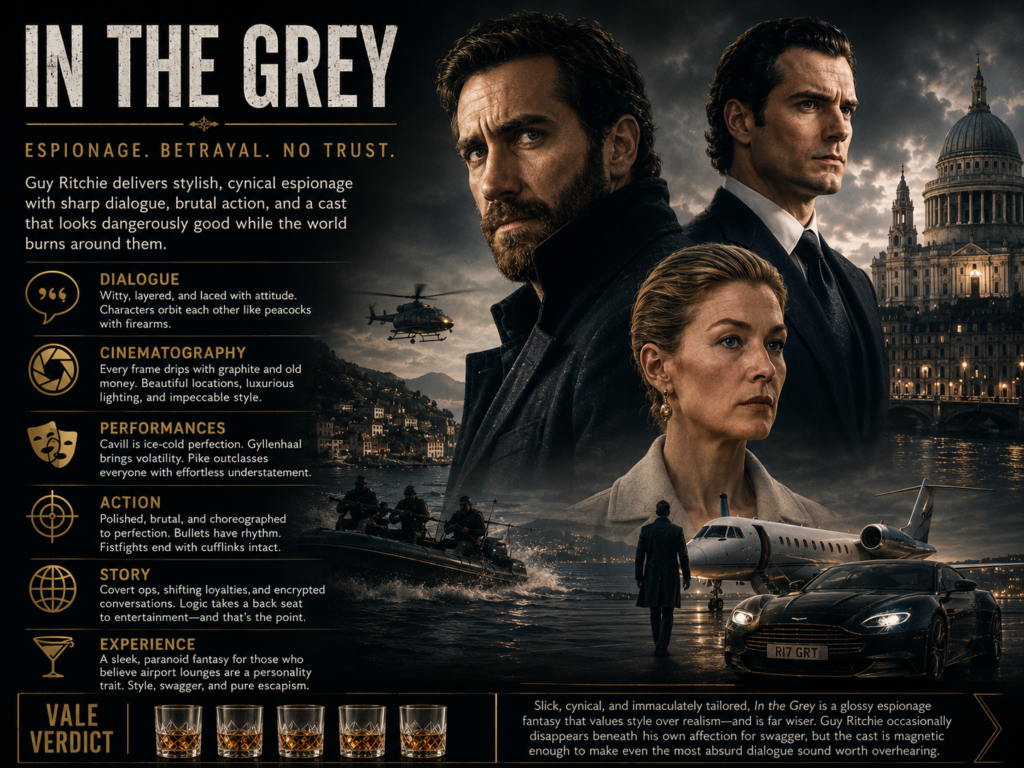
In The Grey
Directed by: Guy Ritchie

There are action films, here are espionage films, and then there are films that desperately wish to be mistaken for espionage films be cause someone handed the cast excellent tailoring and dimly lit a whiskey decanter in the back ground. In the Grey lives some where between those worlds, hovering elegantly above logic while remaining deeply commit ted to looking expensive.
Guy Ritchie, patron saint of hyperactive masculinity and conversational gun-play, delivers precisely what one expects: at tractive people speaking in load ed half sentences while standing near exotic architecture. Jake Gyllenhaal appears permanent ly five minutes away from betraying someone. Henry Cavill continues his campaign to be come the human embodiment of a Tom Ford campaign with military clearance. Rosamund Pike, meanwhile, glides through the film like a woman privately
aware she wandered in from a far more intelligent screenplay.
The premise involves covert extraction operations, shifting allegiances, and enough encrypted dialogue to make a NATO analyst request aspirin. Details scarcely matter. Nobody watches a Guy Ritchie espionage thrill er for geopolitical realism. One watches for the sensation of competence. The fantasy that every dangerous person in the world is also devastatingly well groomed.
And on that front, In the Grey succeeds magnificently.
The action sequences possess a polished brutality that feels imported from a luxury automotive advertisement. Bullets arrive with choreography. Fistfights conclude with cufflinks still intact. Entire intelligence networks collapse while Cavill’s beard remains mathematically symmetrical. It is absurd, naturally, but the film understands the value of confidence. A quality increasingly absent from modern cinema, where every protagonist now arrives burdened with childhood trauma and emotional journaling.
Here, mercifully, people simply shoot each other and board private aircraft.
Ritchie’s dialogue remains both his greatest strength and most exhausting indulgence. Characters rarely converse. They orbit one another verbally like peacocks with firearms. Every exchange carries the energy of wealthy men attempting to out wit each other at a cigar club none of us were invited to join.
At times it sparkles. At others it sounds like three luxury watch advertise ments arguing in a wine cellar. Still, one cannot deny the entertainment value of an action-packed production.
The cinematography deserves particular praise. Every frame appears dipped in graphite and old money. Mediterranean coastlines shimmer ominously. London glows with the sort of impossible rain that only exists in spy films and Burberry commercials. Even the safe-houses have better lighting than most boutique hotels in Miami.
As for the performances, Cavill understands the assignment perfectly. He
has mastered the art of appearing simultaneously dangerous and faintly
annoyed someone touched his Aston Martin. Gyllenhaal injects volatili
ty into scenes that might otherwise collapse beneath their own coolness.
Pike, effortlessly superior to everyone around her, wisely chooses under
statement and wins the film almost by default.
Does In the Grey make complete sense? Certainly not. Half the alliances
shift so often one suspects the screenplay itself required counterintelli
gence clearance. Yet coherence is beside the point. This is luxury paranoia
for audiences who believe airport lounges are a personality trait.
And frankly, it is refreshing.
Vale Verdict: In the Grey glides through violence and betrayal with the confidence of a film that knows precisely how attractive it is. Slick, cynical, and immaculately tailored, it revives the lost pleasure of watching dangerously competent people say cryptic things in beautiful locations while civilization quietly burns in the background. Guy Ritchie occasionally disappears beneath his own affection for swagger, but the cast is magnetic enough to make even the most absurd dialogue sound worth overhearing. A glossy espionage fantasy that values style over realism and is far wiser.
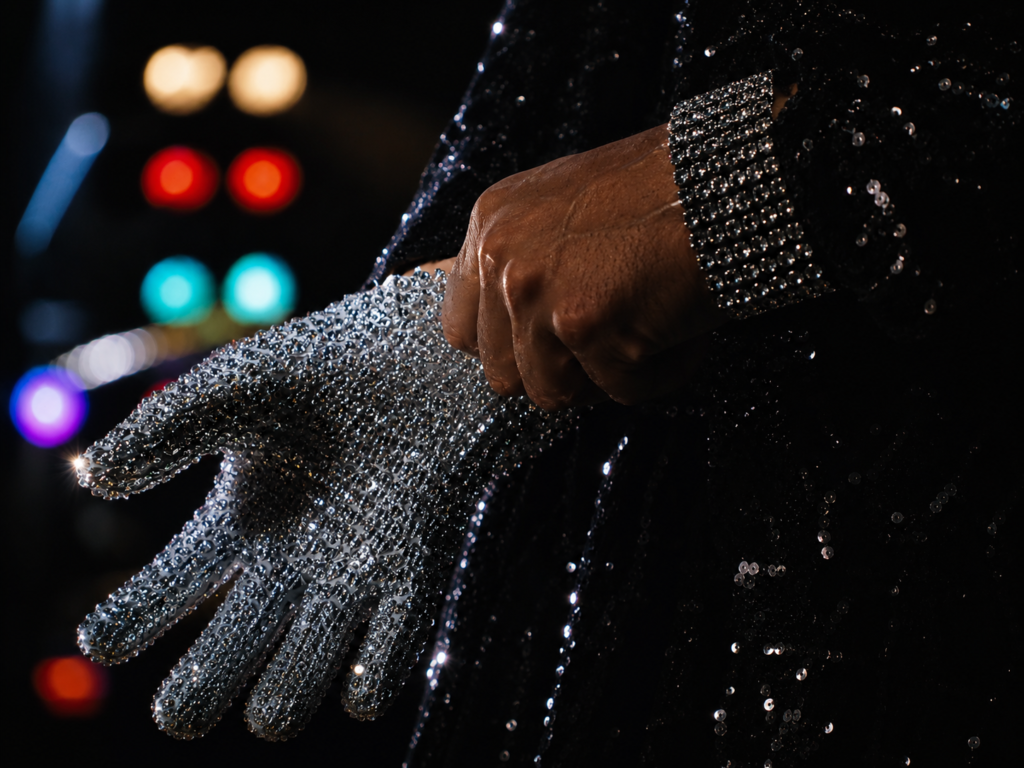
Michael
Directed by: Antoine Fuqua
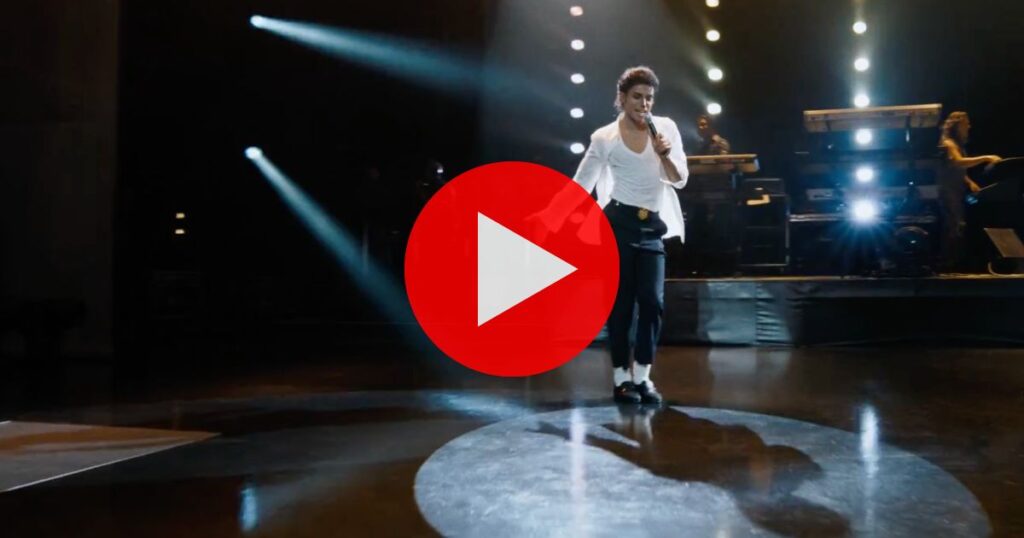
I ducked into Michael on a rainy afternoon with expectations reserved for two and a half hours of sequins, spectacle, and the complicated mythology of the most famous pop star on Earth. A Michael Jackson biopic should overwhelm you a little. It should sparkle, unravel, and occasionally leave you uncomfortable enough to sit quietly through the credits.
Jaafar Jackson shines through the performance. There are moments where he moves across the stage and the audience collectively forgets they’re watching an actor.
The musical sequences are unquestionably the film’s greatest achievement. The Thriller recording sessions crackle with energy, while the Motown 25 performance is staged with enough electricity to remind audiences why Michael Jackson permanently altered the DNA of pop culture. During Billie Jean, Antoine Fuqua finally stops directing a standard biopic and starts directing something closer to cultural memory. Even I, a man professionally trained to resist emotional manipulation, caught myself leaning forward with an involuntary grin.
What ultimately keeps Michael from greatness, however, is its fear of confronting the uglier realities surrounding the man at its center. The film acknowledges allegations of abuse by Joseph Jackson, but only cautiously. Personally, I think that restraint weakens the story. You cannot fully explain Michael Jackson’s loneliness, perfectionism, or fractured sense of identity without honestly examining the environment that created him.
Then comes the larger issue hovering over the entire film, the allegations that permanently complicated Jackson’s legacy. The screenplay largely sidesteps them, and while defenders argue the film’s timeline doesn’t fully extend into that chapter of his life, audiences are hardly walking into theaters with selective amnesia. The avoidance becomes distracting in itself. You can practically feel the movie nervously changing the subject whenever it drifts too close to uncomfortable territory.
Now, do I think Michael needed to transform into a courtroom drama or a tabloid exposé? Absolutely not. The film works best when it focuses on artistry, celebrity, and the brutal cost of becoming a global obsession before adulthood. But I do think the movie underestimates audiences by assuming honesty would somehow diminish Jackson’s brilliance. Complexity would have strengthened the tragedy, not weakened it.
Instead, Michael often feels like an expensive museum exhibit, dazzlingly curated and emotionally moving, but careful not to let visitors linger too long near the cracks in the glass. Still, there’s no denying the power of the experience. The music rattles the walls, the performances soar, and Jaafar Jackson carries the entire production with charisma so convincing it occasionally borders on eerie.
Vale Verdict: Michael dazzles whenever it performs and retreats whenever it should interrogate itself. A thrilling, frustrating portrait of genius that mistakes protection for honesty just often enough to keep greatness out of reach.
The Devil Wears Prada 2
Directed by: David Frankel
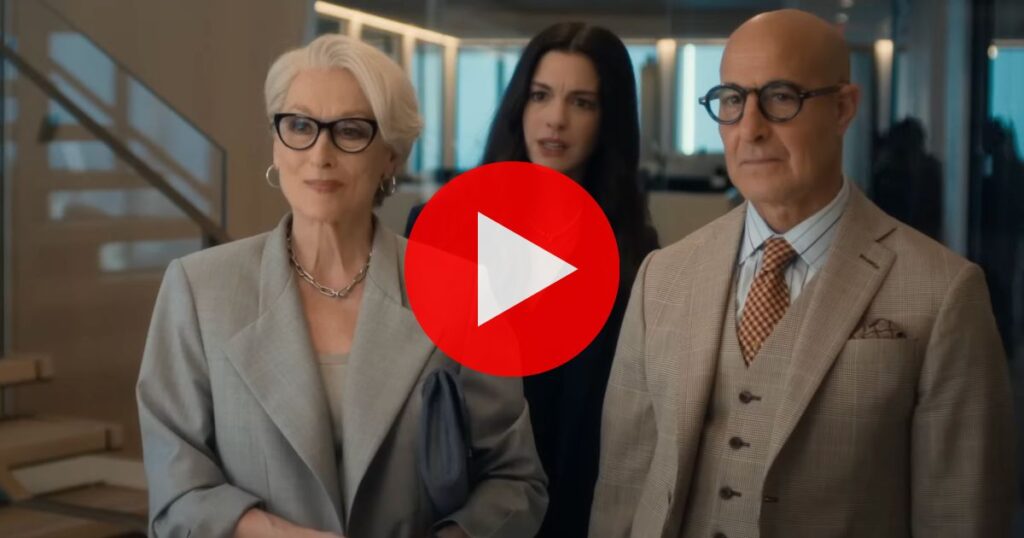
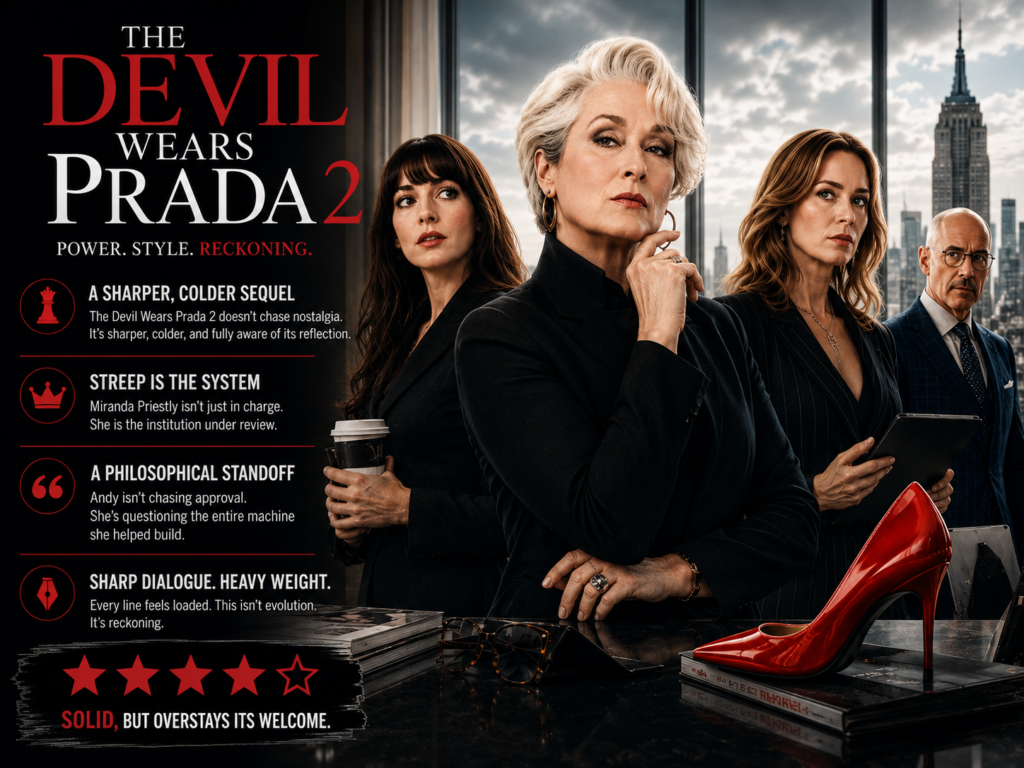
The Devil Wears Prada 2 doesn’t bother chasing the original’s sparkle. It cuts straight past it. What replaces it is sharper, colder, and far more aware of its own reflection.
The script leans hard into compromise, legacy, and the slow, creeping panic of irrelevance, and it doesn’t soften the blow. Dialogue feels loaded, sometimes brutally so, like every character walked in already knowing the verdict. This isn’t evolution. It’s reckoning. And the writing makes sure no one escapes it clean.
Meryl Streep’s Miranda Priestly returns with that signature, unshakable control, but the framing has shifted. She’s no longer just the woman in charge. She’s the system under review. An institution staring down the possibility that influence has an expiration date. Her lines land as statements about power, survival, and staying relevant.
Anne Hathaway’s Andy meets her there, not beneath her. This version of Andy isn’t chasing approval. She’s questioning the entire machine, fully aware she helped keep it running. The tension between them feels less like rivalry and more like a philosophical standoff.
Emily Blunt slides back in with precision, her Emily sharper, faster, and far less patient. Every line feels engineered to leave a mark. Stanley Tucci’s Nigel, meanwhile, operates as the film’s quiet conscience, offering moments of clarity in a world that rarely pauses long enough to notice itself unraveling.
A few subplots arrive dressed to impress but never quite justify their presence, and some returning characters feel more like obligations than necessities. Midway through, the film starts to drag, and attention drifts as it circles its themes a bit too long. Still, when it refocuses, it delivers. This isn’t about nostalgia. It’s about interrogation, even if it occasionally overstays its welcome.
