HARRISON'S ESSENTIALS
Leaving the Island Without Permission
At lunch last week, a woman I will not name because she would be delighted, informed me that Palm Beachers do not leave the island. She issued this decree after I recounted Finnegan’s golf-cart adventure, an evening involving sound-activated roof lights, programmable LED whips, melting ice cream and, by the following morning, a traffic citation in my perfectly legal Bentley. Her expression suggested I had spent the weekend stripping copper wire from a condemned motel.
“People in Palm Beach don’t leave the island,” she said, lowering her voice to ensure the neighboring tables understood that mainland travel was a character defect.
“Perhaps the people you know have nowhere else to be,” I replied.
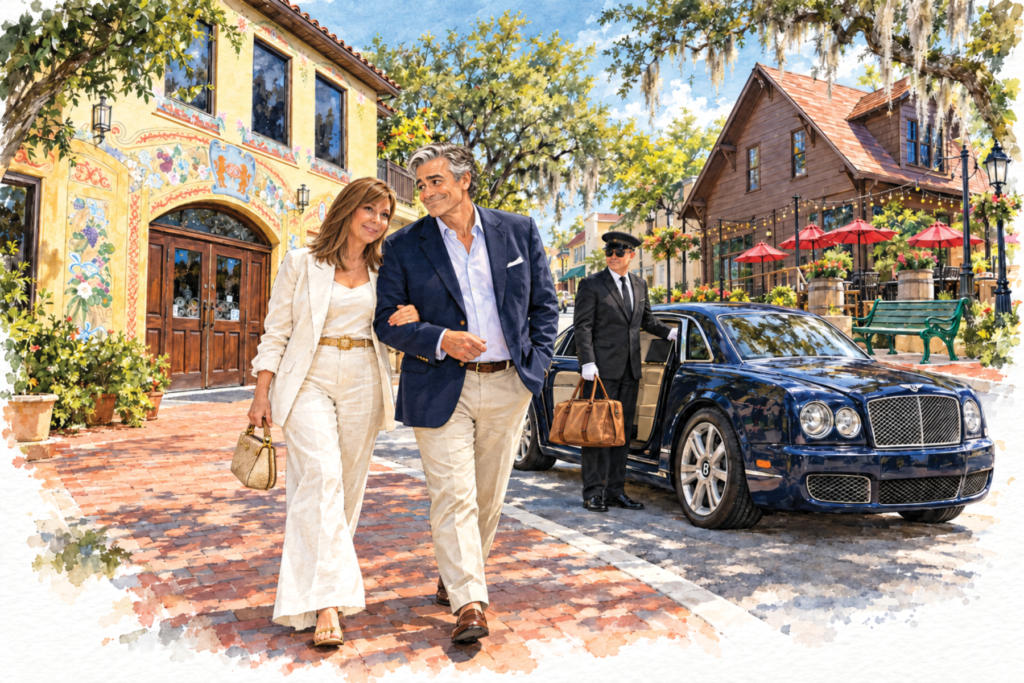
By dinner, I had booked a weekend in Mount Dora.
I invited several friends who live beyond the bridge, yet somehow possess passports, suitable dinner clothes and a working knowledge of flatware. I also invited Camille, which may require a brief explanation.
Camille Mercer is my girlfriend. Some readers may object to learning this several months into the relationship, although my personal life is not a quarterly earnings report. Camille lives in a restored house in El Cid and owns a respected gallery and private art advisory on South Dixie Highway. She refers to Palm Beach as “across the bridge,” a phrase I initially corrected and have since learned to tolerate.
We met through an unnecessarily efficient social procedure involving a numbered card, a brass bell and interference by Finnegan. That is all I am prepared to reveal. Camille has threatened to provide her own account, which is precisely why she has remained largely absent from these pages.
She will be joining me in the Lakeside Inn, while our friends stay elsewhere. The arrangement gives us a king bed, private bath, dinette and sitting area with a fireplace. It also allows me to experience a bed and breakfast without sleeping directly beneath strangers or sharing a bathroom with anyone who travels with herbal shampoo.
My driver will take us to Mount Dora and remain available throughout the weekend. Camille questioned the symbolism of declaring my independence while sitting in the back of a chauffeured Bentley. I explained that rebellion is a matter of principle and need not involve three hours behind the wheel or complicated calculations concerning winery tastings.
Our plans include antique shopping, a private cruise through the Dora Canal and dinner at The Goblin Market, whose unfortunate name is redeemed by duck breast, filet mignon, rack of lamb and a respectable Champagne list. We will also dine overlooking Lake Dora at Pisces Rising, where I have requested a table positioned to appreciate the sunset without requiring me to stare directly into it.
The wineries are Camille’s contribution. Lakeridge produces wines from muscadine grapes alongside more familiar varietals, while Whispering Oaks makes wine from blueberries, a sentence I have repeated several times in the hope that it will improve. “We should buy some,” Camille said. When I reminded her that we hadn’t even tasted it, she replied, “That has never stopped you from buying anything else.” This is the difficulty of dating a woman who listens.
I expect to return Sunday with several antiques, a collection of restaurant receipts and at least one bottle of blueberry wine that Camille will insist belongs in my cellar. The woman who inspired this expedition will undoubtedly ask where I have been. I shall say “Mount Dora” and watch the drawbridge rise behind her eyes.
Palm Beach may be an island. I refuse to become one.
No Interest Whatsoever.
I have reached the conclusion that modern banking is no longer a service. It is an obstacle course with marble floors, limited Saturday hours and a customer-service department trained to express concern without producing anything resembling assistance.
Years ago, while visiting my house in Nantucket, I accepted a premier banking package supposedly reserved for a select tier of clients. The banker presented it with considerable ceremony, as though I were being admitted to a secret financial society rather than receiving a checking account with better stationery. Among its many privileges was a complimentary safe-deposit box.
I may have used it. I may not have. I do not remember, and until recently, I did not care. If I placed anything inside, it was probably an insurance document, an obsolete passport or cuff links I had already decided were too small. I sold the Nantucket house years ago and assumed the bank account, the complimentary box and the banker’s theatrical reverence had all drifted into history together.
The bank had other plans. Apparently, somewhere between then and now, it changed the terms of its premier banking program and removed the complimentary safe-deposit box. The box remained, but the privilege did not. It had quietly transformed into a fee-generating metal drawer hundreds of miles from my home.
I was undoubtedly notified. Banks adore notifications because they allow institutions to claim they have communicated without confirming that anyone has actually read a word. I refuse to read small print and rarely open routine mail. I have people for these things, although even the most capable assistant cannot manage correspondence that I have deposited directly into the trash.
By the time one envelope survived my sorting system, the modest box fee had acquired late charges, legal language and warnings about the possible ruination of my credit score. Nothing sharpens one’s attention quite like learning that an abandoned metal compartment in Massachusetts may jeopardize decades of financial responsibility.
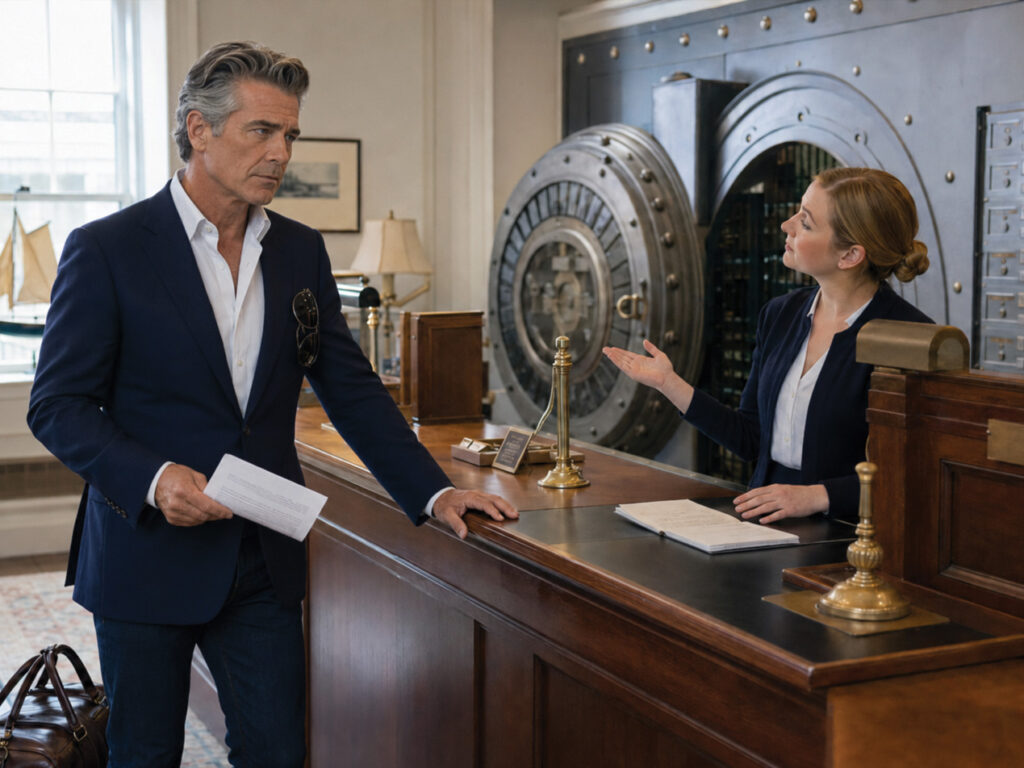
I called the bank and explained that I wished to close the box. The representative informed me that I would need to appear in person. Ordinarily, I would object to flying more than a thousand miles to close something I do not remember opening. However, I am always receptive to an excuse involving a private jet and Nantucket, so I arranged a short weekend visit. I landed Saturday morning and made the bank my first stop, arriving well within its generous operating window of 9 a.m. to noon.
The teller listened patiently before informing me that safe-deposit matters required an appointment during the week.
I explained that the bank had instructed me to appear in person. She agreed that it had. I pointed out that I was now standing in person inside the bank. She agreed with that as well. Unfortunately, I had arrived on the wrong day to be the correct person.
I returned home without closing the box, learning what it contained or encountering anyone willing to take responsibility for either problem. On Monday, I called the bank’s corporate headquarters and suggested a fairly obvious solution: Send me an affidavit, verify my identity, collect whatever fee they believe I owe and close the wretched thing.
This, I was told, was not part of their protocol.
Of course it wasn’t. Protocol is the fortified wall behind which customer service goes to avoid making decisions. Several representatives expressed sympathy, although one particular snarky teller suggested I withdraw my funds and take my by banking elsewhere. However, no one possessed the authority, imagination or apparent telephone extension required to resolve it.
The safe-deposit box therefore remains open. Its contents remain a mystery. The fees are presumably continuing to accumulate, and somewhere in Nantucket, a small metal drawer has achieved greater control over my travel schedule than most members of my family.
If the bank eventually drills it open, I hope they discover something valuable. At this point, an employee willing to take ownership of the problem would qualify.

A Beaver Too Far
Earlier this week, I was speaking with a favorite cousin of mine, who happens to live in Ohio, where a particularly absurd piece of corporate theater is unfolding. I use the word “favorite” carefully. Family rankings, like good silver, should rarely be displayed in public.
She asked if I had heard about Buc-ee’s suing Beaver’s Mini Mart, a modest convenience store in Beavercreek. I had not. I assumed she was describing a parody invented during a long lunch.
Regrettably, it is real.
Buc-ee’s filed a federal trademark lawsuit against the local shop, arguing that its cartoon beaver, smiling expression, and use of red might confuse customers. Buc-ee’s opened its first Ohio location in April, roughly thirteen miles from Beaver’s Mini Mart, then filed suit on July 28. The corporate beaver wears a red cap inside a yellow circle. The Beavercreek beaver stands upright, gestures toward the store’s name, and offers a thumbs up. I have seen greater resemblance among men wearing navy blazers at charity dinners, yet no one has summoned a federal judge.
Buc-ee’s insists it is protecting a valuable trademark. Its chief executive has said the company took no pleasure in filing suit and would drop the case if Beaver’s Mini Mart withdrew its own trademark application.
How terribly noble.
I understand the obligation to protect intellectual property. A brand is an asset, and any competent steward guards an asset carefully. Competence, however, also requires proportion. One must be able to distinguish a genuine commercial threat from a small shop using a local animal in a city called Beavercreek.
The community’s association with the beaver dates to 1803, when Beavercreek Township was named for Big Beaver Creek and Little Beaver Creek. The City Council has since voted unanimously to affirm the beaver as a historic symbol of the community. Buc-ee’s may own its particular drawing. It does not own the animal, the color red, smiling, wide eyes, Ohio history, or apparently, common sense.
One might have thought corporate America would remember the Cracker Barrel logo debacle. Barely a year ago, that company removed Uncle Herschel and his barrel from its familiar logo, endured a national revolt, watched nearly $100 million in market value disappear, and restored the old design within a week.
People have forgotten remarkably quickly.
To be clear, I have never entered a Cracker Barrel. I have no intention of eating anything called a Beaver Nugget, and I undoubtedly have not touched a filthy gas pump handle in decades. I have people for one of those tasks and standards that preclude the other two.
Even from this comfortable distance, the lesson is obvious. Corporate executives routinely underestimate the emotional ownership customers and communities feel toward familiar symbols. Cracker Barrel treated its history as disposable. Buc-ee’s treats a cartoon rodent as private territory. Both companies allowed boardroom reasoning to overwhelm ordinary judgment.
What fascinates me is the peculiar belief among large corporations that these frivolous exercises actually benefit them.
Perhaps executives imagine the public will admire their vigilance. Perhaps someone presented a slide labeled “Brand Protection Strategy” and everyone nodded with grave importance. It is amazing how quickly foolishness acquires dignity once placed in a presentation and assigned outside counsel.
The practical result is rather different.
Beaver’s Mini Mart now has community support, a legal defense fundraiser, national publicity, and customers rallying to its side. Buc-ee’s has transformed a neighborhood convenience store into a sympathetic underdog while casting its own enormous beaver as the villain. That is quite an accomplishment. One could hire a very expensive public relations firm and still struggle to manufacture such damaging publicity.
There is a point at which aggressive brand protection becomes brand vandalism. Customers do not admire a company for selecting a much smaller opponent and burying it in legal costs. They see insecurity, vanity, and an alarming shortage of adult supervision.
The most powerful institutions understand restraint. They do not answer every perceived slight, pursue every technical advantage, or mistake the ability to apply pressure for a reason to do so. They choose their battles with care because reputation is far more difficult to repair than a trademark registration.
My cousin tells me the people of Beavercreek are enjoying the spectacle, which seems entirely appropriate. A corporation arrived in town, challenged a local beaver, and discovered that Ohioans possess both a sense of humor and a rather firm opinion about bullies.
Buc-ee’s may yet prevail in court. Legal victory, however, is not the same as good judgment. A company can win its claim and still lose the room.
Real stature requires proportion. Power is most persuasive when it knows when to leave the beaver alone.

Rear Ended by Formalities.
I have always believed modern medicine works best when the patient arrives promptly, answers only the questions that matter and leaves before anyone attempts to discuss cholesterol. This arrangement has served me perfectly well for years. Unfortunately, it does not apply to colonoscopies, which apparently require a supporting cast, a transportation plan and the temporary surrender of one’s dignity.
My physician recommended the procedure with the casual confidence of a man who would not be drinking the preparation. I accepted the medical necessity without protest. I am nearly sixty, and while I consider this a clerical error, certain parts of the body have begun requesting official inspections. What I did not anticipate was that the hospital would become intensely interested in my social life.
A woman from scheduling called to arrange the appointment and informed me that I could not drive myself home. This seemed reasonable, since I would be sedated and presumably in no condition to select an appropriate route, much less operate a Bentley. I told her I would take an Uber.
“You cannot take an Uber,” she replied.
“Then I’ll take a car service.”
“That is also not permitted.”
I asked if the hospital had developed a personal grievance against professional drivers. She explained that I must arrive with a responsible adult who would remain on the premises, listen to the discharge instructions and escort me home. I found the phrase “responsible adult” needlessly judgmental. I am surrounded by adults, although very few of them have displayed enough responsibility to qualify for medical transportation.
My chauffeur would seem the obvious solution, except he is currently refusing all post-sedation assignments. The clause appeared in his contract after my last dental procedure, when I spent the ride home attempting to purchase a toll bridge and appoint him its director of transportation. He maintains that colonoscopy anesthesia may produce similar behavior, and he is unwilling to spend another afternoon explaining to me that public infrastructure is not for sale.
My closest friends are perfectly pleasant over dinner, but asking one of them to accompany me to a colonoscopy would alter the relationship beyond repair. There are boundaries between gentlemen, and the digestive tract is several miles beyond them. Family was equally impossible. I refuse to provide relatives with a story they could repeat at Thanksgiving for the next twenty years.
This left acquaintances. I pictured calling someone I had met briefly at a gala, perhaps the fellow who complimented my dinner jacket while we waited for the auctioneer to stop shouting. What does one say?
“Good afternoon. We met beside the champagne tower at the Preservation Foundation benefit. You admired my lapels. Would you care to spend Tuesday morning in a gastroenterology waiting room and assume legal custody of me afterward?”
There is no wording elegant enough to rescue that invitation.
I explained this predicament to the scheduler, who responded with the sort of silence usually reserved for people negotiating with a parking meter. I then proposed bringing my cat. He is punctual, discreet and considerably more responsible than half the people seated at any Palm Beach charity dinner. He would not interrupt the discharge instructions, ask intrusive questions or post a photograph of my hospital bracelet. His inability to drive was admittedly inconvenient, but no more so than the hospital’s refusal to let a professional do it.
“Sir, a cat cannot serve as your companion.”
“That sounds discriminatory.”
“It is hospital policy.”
“Then you have left me with no alternative. If you will not permit me to Uber home, you shall have to consider me a permanent resident of the hospital. I’ll require a private room, decent linens and somewhere to store a case of Bordeaux.”
She began to say something about insurance.
“I should also warn you that I dislike fluorescent lighting, lukewarm coffee and televisions mounted too close to the ceiling.”
She hung up.
I have not yet scheduled the colonoscopy. The medical establishment may consider this a failure of patient compliance, but I consider it an unresolved transportation dispute. My cat remains available, Uber remains willing, and I am prepared to move into the hospital indefinitely if necessary. I simply hope they understand that permanent residency includes valet parking.

Sub. Zero. Miracles.
I have long suspected that the modern luxury kitchen has very little to do with cooking. This may seem like a curious conclusion coming from a man whose kitchen contains a six-burner Wolf cooktop, dual Sub-Zero refrigeration columns, a wine preservation system capable of protecting bottles older than some elected officials, and enough imported stone to pave a respectable section of Tuscany. Yet the more kitchens I have seen, the more convinced I become that they are less about preparing meals and more about pursuing a certain vision of ourselves.
Nobody spends six figures renovating a kitchen because scrambling eggs have become technically impossible. They do it because kitchens have quietly replaced therapy, self-improvement seminars, and occasionally religion as the preferred vehicle for personal transformation.
I know this because I once endured a renovation that seemed destined to outlast civilization itself. My former wife became convinced that our perfectly functional kitchen was standing between us and a more enlightened existence. The room worked beautifully. Meals emerged from it with admirable consistency. Yet because it lacked imported marble and the sort of lighting favored by luxury resorts, it was apparently preventing us from becoming the kind of people featured in architectural magazines smiling over untouched charcuterie boards.
The appliance decisions were particularly exhausting. We eventually selected a Wolf cooktop large enough to accommodate a diplomatic summit and equipped with enough power to sear steaks for an army. It was magnificent, even if the only person regularly using it was our chef.
Then came the Sub-Zero refrigeration system, which occupies a unique position in American luxury culture. A Sub-Zero is not simply a refrigerator. It is a social signal disguised as an appliance. It tells visitors that your vegetables enjoy superior living conditions and that you have strong opinions about food preservation despite regularly eating lunch at the club. Owners speak of Sub-Zero with the reverence usually reserved for rare watches, vintage Ferraris, and grandchildren who attend Ivy League universities.
When the project was finally completed, the results were undeniably spectacular. The marble gleamed beneath perfectly calibrated lighting, the cabinetry aligned with Swiss precision, and every appliance stood in place like a highly decorated officer awaiting inspection. Friends admired it. Designers photographed it. Contractors proudly referenced it in future presentations. Yet despite the beauty, expense, and months of collective obsession, the renovation accomplished remarkably little for the relationship that had inspired it. This is not a criticism of kitchens. It is simply an acknowledgment that imported stone possesses surprisingly few therapeutic qualities.
Still, I understand why people continue chasing the perfect kitchen. It represents the life we hope to live rather than the one we actually do. We imagine ourselves hosting elegant dinner parties, preparing family recipes, gathering around enormous islands, and opening exceptional bottles of wine while guests linger long after dessert. The kitchen has become a stage upon which we perform our aspirations.
The irony is that the happiest meal I have enjoyed this year was a cheeseburger consumed while standing at a marina waiting for fuel. There was no marble. No designer lighting. No imported hardware. Nobody discussed backsplash materials or drawer organization systems. Nobody uttered the phrase “transitional contemporary.” It was simply good food, good company, and complete freedom from conversations about countertop edge profiles. Looking back, it may have been the most luxurious dining experience of all.

Precision Living for a Longer Game
One cannot discuss longevity with any seriousness while continuing to eat as though consequence were a rumor. I say this as someone who has spent a respectable portion of his life ordering with enthusiasm and very little restraint. The palate, after all, has its standards. But time, again, is an unforgiving editor.
If fitness is the visible discipline, nutrition is the private one.
Organic eating, when approached properly, is not a trend or a performative gesture. It is a quiet recalibration. A decision to favor ingredients that have not been tampered with beyond recognition. Fewer chemicals, fewer interventions, and, perhaps most importantly, fewer surprises for a body that now prefers consistency over chaos.
There is, admittedly, the question of convenience. One can only be expected to browse farmers markets so often before patience begins to thin. This is where modern luxury redeems itself. My personal solution arrives in the form of Rosetta’s Food Box, which delivers organic produce directly to my door with a level of reliability I find deeply reassuring. Fresh vegetables, properly sourced fruits, and the sort of quality that makes one feel vaguely virtuous without any public display. They offer prepared meals as well, along with high quality pantry staples, which means even on less disciplined days, standards need not slip.
The science, fortunately, aligns with the philosophy. Diets centered around whole, minimally processed foods are associated with reduced inflammation, improved metabolic function, and a lower risk of chronic disease. These are not abstract benefits. They translate directly into energy, clarity, and the ability to maintain a certain standard of living without compromise.
And then, inevitably, one begins to explore the more advanced corners of modern wellness.
Peptides, for instance, have entered the conversation with a certain quiet authority. Not quite mainstream, not entirely fringe, and best approached with guidance rather than enthusiasm alone. In essence, they are short chains of amino acids that signal the body to perform specific functions, often related to repair, recovery, and cellular efficiency. Under proper medical supervision, certain peptide therapies are being used to support muscle maintenance, improve recovery times, enhance sleep quality, and even contribute to skin health. It is less about dramatic transformation and more about subtle optimization, which, frankly, is far more appealing.
This is where concierge medicine proves its value. Regular blood work, hormone panels, and tailored protocols ensure that any intervention, peptides included, is precise and appropriate. Guesswork is replaced with data, and decisions feel less like experiments and more like strategy.
Longevity clinics take this philosophy further, focusing on preserving function at a cellular level. It sounds extravagant until one considers the alternative. Preventative care, when executed well, is simply intelligent living.
Even the spa has evolved beyond its former reputation. Treatments now center on recovery and performance. Cryotherapy, infrared saunas, lymphatic therapies. Each designed to support the body’s ability to maintain itself with minimal fuss and maximum effect.
Biohacking, when stripped of its more theatrical proponents, becomes something rather sensible. Better sleep, improved nutrition, strategic supplementation, and, where appropriate, medically guided enhancements like peptides. Small, deliberate adjustments that yield measurable returns.
And yet, none of it replaces the fundamentals.
Eat well. Move consistently. Monitor intelligently.
The objective is not immortality. It is continuity. The ability to enjoy the life one has built without interruption, without decline becoming the dominant narrative.
Longevity, when approached with taste, is less about extending time and more about refining how it is spent.
A Different Kind of Southern Comfort
I traded ocean views for neon signs this month.
Friends looked genuinely concerned when I mentioned Tennessee. One asked if I’d suddenly taken up fly fishing. Another wondered if this was some sort of spiritual retreat. Hardly. I was chasing something rarer these days, authenticity with a little swagger.
I landed at Nashville International Airport, known simply as BNA, which has absolutely no business being this impressive. BNA somehow feels like an extension of the city itself, warm lighting, soaring wood accented ceilings, live music stages tucked between gates, modern art installations suspended overhead, and enough neon glow reflecting off polished white floors to remind you exactly where you’ve landed. Massive renovations over the last several years transformed the airport into something closer to a luxury hospitality space than a transportation hub.
My first evening began beneath the glowing lights of the legendary Grand Ole Opry, a sacred ground for American music. Since 1925, the Opry has hosted generations of country legends and remains the longest running weekly radio show in the world.
Inside, the energy is impossible to fake. Cowboy boots click against polished floors while voices rise beneath the same stage lights that once framed Johnny Cash, Patsy Cline, Dolly Parton, and countless others. Even if country music has never occupied your playlists, the experience reaches beyond genre. It feels deeply American and slightly rebellious.
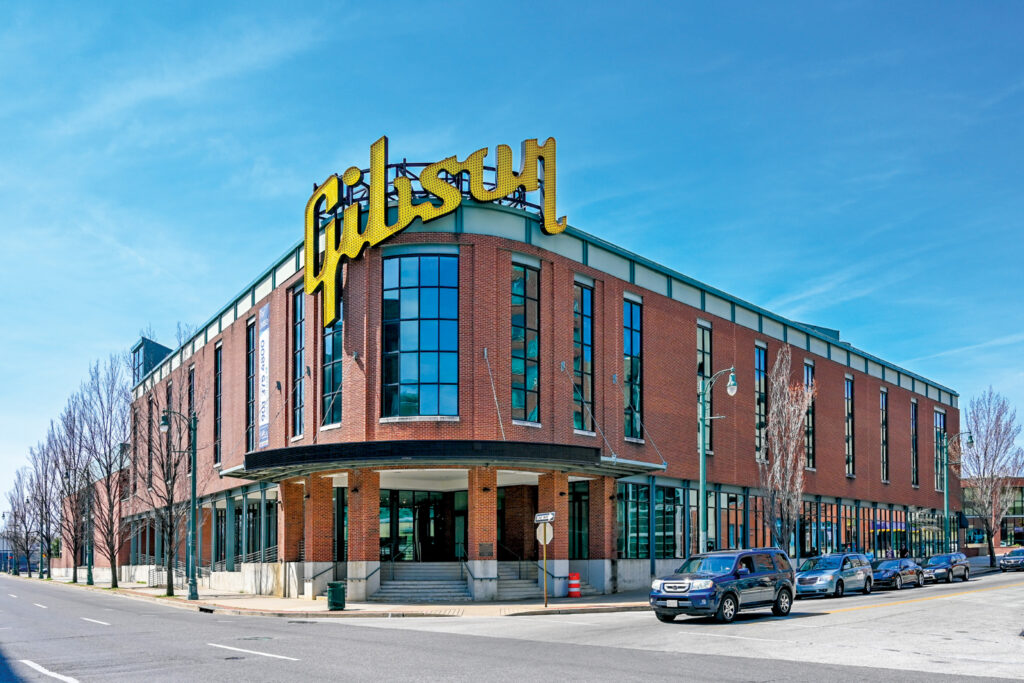
The following morning took me downtown to The Gibson Garage, which may very well be the closest thing guitar lovers have to a cathedral. Located in the heart of Nashville, this flagship showroom is a museum, luxury boutique, and part fever dream for musicians.
Imagine rows of gleaming Les Pauls suspended overhead like artwork. Vintage acoustics displayed beneath dramatic lighting. Limited edition customs with finishes so flawless they belong behind glass. I watched seasoned musicians pick up six figure instruments with the kind of reverence normally reserved for rare watches or rare Ferraris.
Fortunately, reason returned around the same time I wandered into the acoustic room and heard a man casually play a version of “Tennessee Whiskey” so hauntingly beautiful the entire room stopped moving. Nashville has that effect on people.
The city’s luxury scene, however, extends far beyond music.
The following afternoon led me to Nashville Barrel Company Distillery and Whiskey Bar, a sophisticated whiskey destination hidden inside an industrial style distillery just outside the city center. This was not your average tourist tasting filled with syrupy flights and gimmicks, but rather an experience centered around beautifully aged bourbon and rye poured with confidence.
The tasting room carried notes of charred oak, leather, caramel, and spice. Bottles rested behind glass like rare jewels. I sampled a single barrel cask strength rye that arrived with enough complexity to rival certain Scottish single malts commanding four digit prices at auction.
The locals discuss whiskey the way Europeans discuss wine. They debate barrel finishes. They compare aging climates. They know which pours disappear within hours of release.
A short drive beyond Nashville’s brought me to Lynchburg and the iconic Jack Daniel’s Distillery, where Tennessee whiskey begins with cave spring water filtered through limestone and traditions dating back over 150 years. The property vibes felt almost cinematic, with black iron gates, rolling hills, and brick warehouses.
There is something quietly paradoxical about sipping world class whiskey in such an unassuming setting, leaving one to wonder whether the contrast was carefully orchestrated or simply a fortunate accident.
One particular tasting included ultra premium expressions rarely found outside collectors’ circles, rich with maple, smoke, toasted vanilla, and dark cherry.
Tennessee is a must visit. At least once in your life. It’s diverse, complex yet pure. One minute you’re seated beneath crystal chandeliers sipping top shelf bourbon. The next you’re listening to a fiddle player who sounds like true Americana. And that’s my take on this wonderful adventure.
A Season of Better Air
Vol. 645
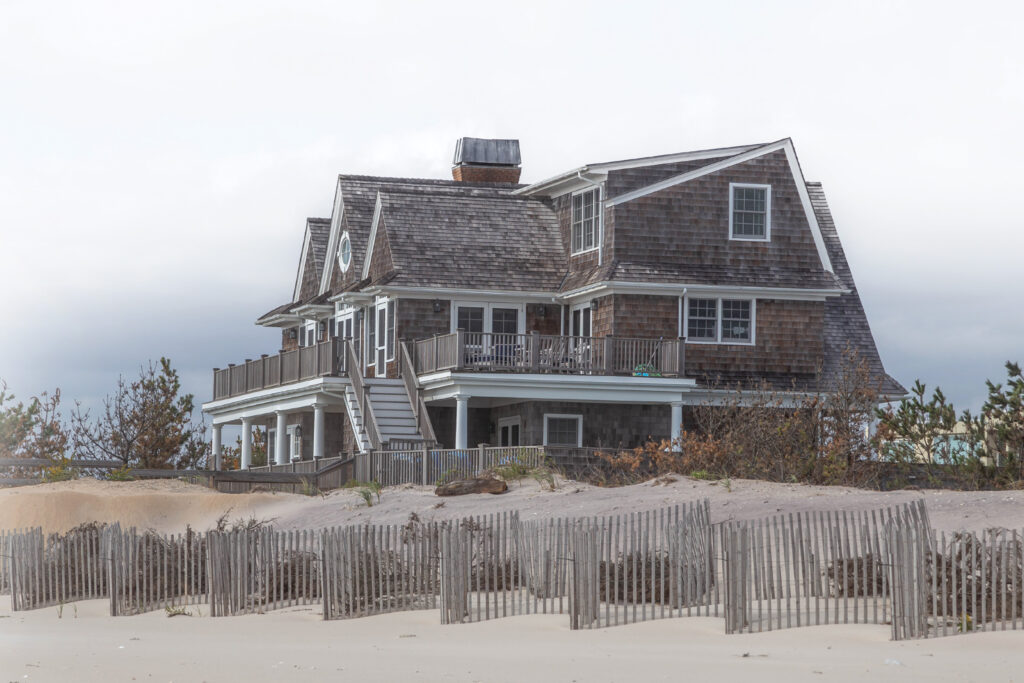
I did not buy in the Hamptons because I enjoy travel. I bought in the Hamptons because I enjoy contrast, and Montauk, in particular, delivers it with a certain dramatic flair.
One cannot ignore the particular allure of driving east, past the last polite traces of Southampton and East Hampton society, where the atmosphere relaxes its grip. The hedges thin, the air sharpens, and by the time you reach Montauk, you are no longer in the Hamptons as most people understand them.
The lighthouse stands at the easternmost point of Long Island, a stark, almost cinematic presence against the Atlantic. Commissioned by George Washington in 1792 and completed in 1796, it remains the first lighthouse built in New York and one of the oldest still operating in the United States. It was designed to guide ships safely into New York Harbor, a task it has performed for over two centuries with quiet, unwavering consistency.
The structure itself rises above the cliffs of Montauk Point, its stone tower enduring Atlantic winds that feel less like weather and more like intention. From the lantern walkway, the horizon unfolds in a manner southern shores cannot quite replicate. Open ocean, uninterrupted horizon, the unmistakable impression of arrival.
Montauk, as a whole, operates differently from the rest of the Hamptons. It is less concerned with presentation and more invested in experience. Yes, there are still the requisite dinners, the inevitable gatherings, the familiar faces migrating east for the season. But here, they are softened by salt air and a slightly more relaxed code of conduct.
You might see the same person you dined with at Buccan now barefoot, holding a glass of rosé, discussing something vaguely existential while watching the sun disappear into the water. It is disarming, and occasionally refreshing.
This is the true luxury of a northern escape.
The climate alone does half the work. Cooler mornings encourage movement. Long walks feel restorative rather than obligatory. Cycling becomes something one looks forward to rather than negotiates with. Even the simple act of sitting outside carries a different energy when the air has a bit of edge to it.
Socially, the shift is equally valuable.
The Hamptons, and Montauk in particular, allow for a bit of improvisation. Discussions extend, evenings gather momentum, and presence becomes intentional rather than obligatory, a refinement in itself.
And then there are the moments that cannot be scheduled. Standing near that lighthouse at dusk, for example, when the light begins its steady rotation, visible for miles out at sea as it has been doing precisely for generations. It suggests, without effort, that permanence has its own form of prestige.
My house, of course, is not far. Close enough to feel connected, far enough to maintain perspective. It exists as a counterbalance to Palm Beach. Where one is sun-drenched and social, the other is windswept and reflective.
This is the real advantage of multiple homes.
Not excess, but variation.
A change in climate, a recalibration of pace, a different version of yourself that emerges depending on where you are. In Montauk, that version is slightly more relaxed, slightly more introspective, and, perhaps, a bit more aware of time passing in a way that feels less urgent.

Vanity on Two Wheels
Vol. 644
I have never been particularly fond of exercise. The very word suggests effort, perspiration, and a level of enthusiasm I reserve for far better pursuits. Left to my own instincts, I would choose a well-poured bourbon over a morning workout every single time… which, of course, is precisely the problem.
Motivation, then, must come from somewhere more compelling than virtue. Preferably something beautiful.
Cycling feels particularly appropriate. It is low impact, efficient, and carries just enough nostalgia to be charming. Whether along palm-lined avenues or waterfront paths, it delivers cardiovascular benefits without the indignity of joint pain. It is, quite frankly, the rare indulgence that gives more than it takes. And, not insignificantly, it produces legs worth noticing. Properly defined, unapologetically sculpted, and, in my case, still drawing the occasional glance just shy of sixty. One does not arrive there by accident.
At this level, a bicycle is less equipment and more accomplice. The sort of object that makes you want to be seen using it. Pinarello, Colnago, S-Works, Bianchi, Cervélo. Names that carry weight, not just in performance, but in presence. These are not bicycles one leans casually against a wall. They are positioned, admired, occasionally adjusted for effect. Carbon fiber frames gleam with intent, every line engineered for speed, every detail whispering precision. Lightweight and responsive.
There is motivation in that kind of craftsmanship. A quiet pressure, really. One cannot own a machine of this caliber and allow oneself to go soft. It would be a mismatch, aesthetically and philosophically. The bike demands something of you. Stronger legs. Better posture. A certain discipline that ensures you look as though you belong on it.
Then, for those who prefer their pleasures with a bit more texture, a cyclocross bike enters the conversation like a well-dressed rebel who refuses to stay entirely civilized.
At first glance, it maintains the same composed silhouette. Look closer, and you see the difference. Wider tires, reinforced frames, geometry that suggests it has no intention of remaining on pristine pavement. The finest cyclocross models, drawn from the same elite houses, blend luxury with a willingness to get slightly untidy. It’s a rare combination, which is precisely the appeal.
This is for the rider who appreciates valet service, yet finds satisfaction in disappearing down a gravel path where no one is watching. Or so one tells oneself. In reality, there is always the hope that someone is. That a passing glance might register the machine, the movement, the unmistakable line of a well-kept calf in motion.
There is a versatility here that feels almost indulgent. One ride moves effortlessly from polished asphalt to uneven terrain, the bike adapting without complaint. And you, ideally, keeping pace with equal composure.
The reward is not subtle. Cardiovascular health improves, muscles strengthen, and the body begins to reflect the effort in ways that are difficult to ignore. The waistline tightens, the legs sharpen, and suddenly, tailored trousers fit exactly as they should. Perhaps better.
For those of us approaching sixty with no intention of fading politely into the background, this is the real currency. Not just longevity, but presentation. The ability to walk into a room, or a dining room at The Breakers, and feel entirely at ease in one’s own form.
Cycling, particularly at this level, offers that. It is discipline disguised as pleasure. Vanity, if we are being honest, dressed up as wellness.
